
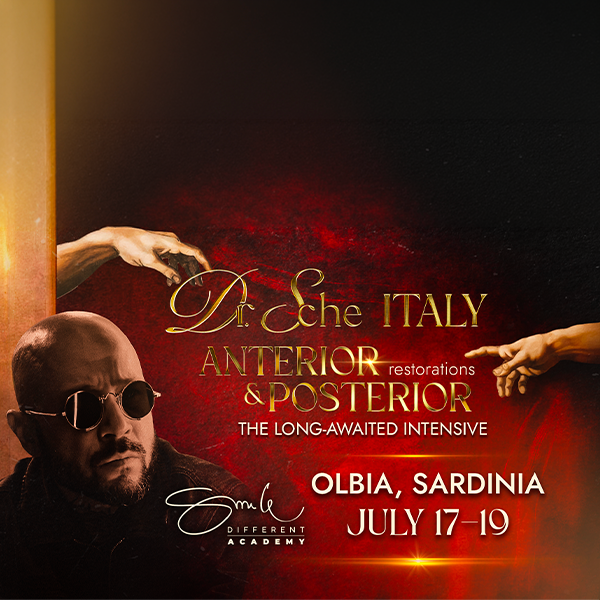
International hands-on course from Dr. Sche. Anterior+Posterior
€1.250,00 - €3.150,00Fascia di prezzo: da €1.250,00 a €3.150,00 + IVA
This legendary course has long established itself in various countries as the world’s most comprehensive and in-depth for those who truly want to learn how to create beautiful, natural, and functional composite restorations. The timing of each day’s work has been increased, classes are held from 09:00 to 22:00, from morning to evening the days are filled with in-depth scientific analysis, study of protocols, techniques, demonstration of work on a microscope and a very large amount of practice (60% of all time is practice). Course participants will also be equipped with microscopes, binocular loupes, various materials, and all kinds of tools to achieve high-quality results. Viktor works in a unique manner, addressing each participant’s mistakes individually and constantly providing constructive feedback.
- Luogo del corso
- Olbia
Programma Corso
Day One: Fundamentals of Anterior Teeth Restoration. Segmental Restorations in Natural Shades.
09:00-11:00 – First Theoretical Block
Part 1: Optics of Tooth Tissues and Composite Materials
• Anatomy of Transparency. What structures can be seen inside anterior teeth, description of optical and histochemical characteristics of tissues. Details of appearance and their variations.
• Protocol for selecting the shade of composite material. Analysis of the optical density of various composite shades.
• Optical and chromatic construction of restorations using the DeepFakeOptics technique. Explanation of all stages, features, and advantages of the technique.
• Features of imitating the dentin body and mamelons. Techniques for characterizing mamelons. Configuration of composite layers when reproducing teeth of varying degrees of transparency, reproducing the Halo effect.
• Corrections of composite material. Proper approach to the necessity of adjustments and refinements. Effective protocol for adhesive preparation of composite material at different stages: within 2 hours after polymerization; from 2 hours to several years.
11:00-11:30 – Coffee Break
11:30-13:30 – Second Theoretical Block
Part 2: Morphology of Anterior Teeth
• Morphology of anterior teeth, variations in the relationship of elements, texture.
• Imitation of the natural irregularity of the incisal edge, perikymata.
• Atlas of forms and surface characterizations. Texture.
Part 3: Finishing of Restorations
• Creating invisible transitions when reproducing segmental restorations without total vestibular coverage.
• Analysis of tools for grinding and polishing.
• Principles and protocols for the most effective finishing.
• Special techniques and methods.
13:30-15:00 – Practical Demonstration by the Lecturer through a Microscope
15:00-16:00 – Lunch
16:00-20:00 – Practical Session
20:00-20:30 – Dinner
20:30-22:00 – Practical Session
Day Two: Bleach Restorations, Veneers
09:00-11:00 – First Theoretical Block
Part 1: Shade and Layer Recipes
• Why the palatal index technique is frequently ineffective for creating bleach restorations. Alternative approaches.
• Implementation of composite veneers in light and white shades using the DeepFakeOptics technique.
• Features of isolating the working field with a rubber dam when performing bleach veneers.
• Preferred composite shades.
• Methods for controlling the thickness and optical density of the material for uniform coverage of the original tooth shade.
• Methods for forming contact points, extending the material to proximal surfaces, using various matrices and techniques.
11:00-11:30 – Coffee Break
11:30-13:00 – Second Theoretical Block
Part 2: Fundamental chemistry of composite
Analysis of the chemical-physical properties and behavior of composite under different circumstances. Detailed and visual reference with a large amount of precise data on the fundamental chemistry of composite materials.
13:30-15:00 – Clinical Workflow Practical Demonstration by the Lecturer through a Microscope
15:00-16:00 – Lunch
16:00-20:00 – Practical Session
20:00-20:30 – Dinner
20:30-22:00 – Practical Session
Day Three: Posterior Teeth Restorations
09:00-11:00 – Theoretical Block
• Detailed analysis of the anatomy and function of posterior teeth. Overview of movements, detailed description of the functional role of each anatomical element of the occlusal surface.
• Overview of restoration techniques for defects of various sizes.
• How to control the spatial positions of constructed anatomical elements when restoring a defect within the occlusal contour?
• Materials and structure of layers for posterior tooth restoration.
• Techniques for individualization, imitation of white spots on enamel, pigmentation of fissures.
• Restoration of the contact point, working with Class 2 defects.
11:00-11:30 – Coffee Break
12:30-14:00 – Practical Demonstration by the Lecturer through a Microscope
14:00-15:00 – Lunch
15:00-20:30 – Practical Session
20:30-21:00 – Dinner
21:30-22:00 – Final Photo Session